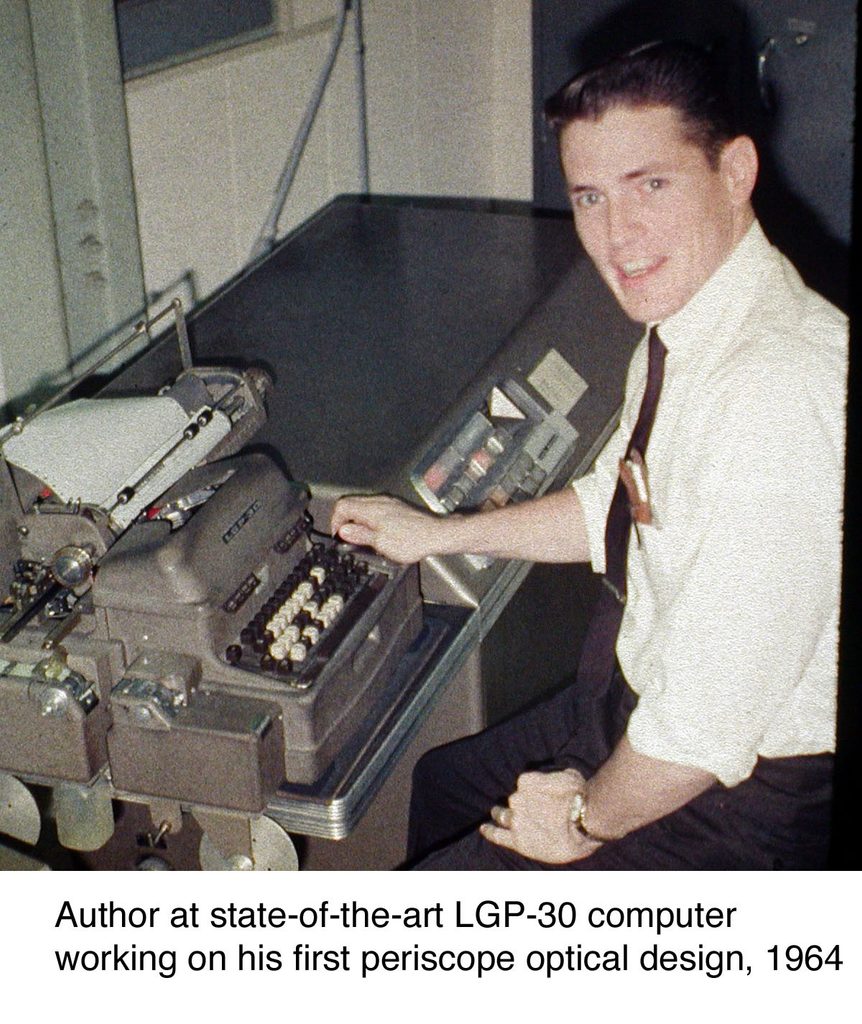
In 1964, I was granted the opportunity to work as a junior lens designer under Harry Friedman, a disciple of Dr. Kollmorgen. My scant experience consisted of a single college course in geometrical optics and a high school lab course in optics. Friedman was “betting on the come” with this youngster under his wing.
I performed ray tracing on the current line of Kollmogen products including modular periscopes for nuclear labs and projecction lenses for the morion picture industry.
In the late 60’s the U.S. Navy created specifications for a submarine periscope with the ultimate highest resolution. Kollmorgen was not included on the initial bidders list because this new advanced periscope, was thought to be out of their league, only for consideration by the country’s largest optical companies specializing in “spy in the sky” type exotic systems.
Through diligence and perseverance the company’s Washington D.C. representatives managed to get Kollmorgen included on the list. Thus, began a crash, all-out effort to prepare an unsolicited proposal that would show Kollmorgen to be a viable option.
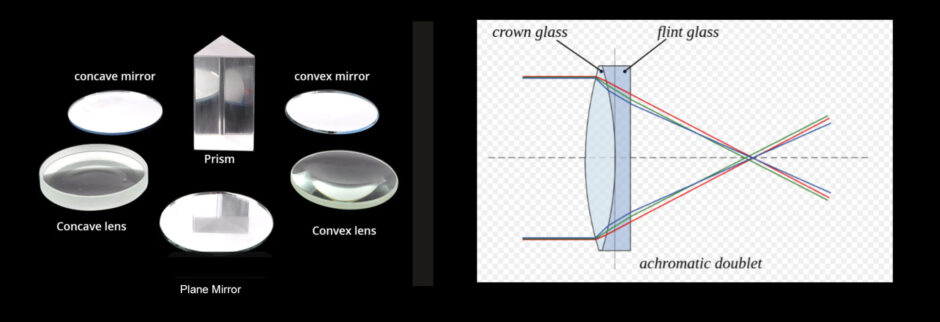
The key objective was to achieve the highest resolution possible, the “diffraction limit’. This was a major challenge, since all periscopes, throughout all countries of the world, were limited in resolution by a residual aberration, “secondary spectrum”, the inability of the optics to bring all wavelengths to the same focal point, necessary to achieve the highest resolution. Being one of only a few optical engineers in the company was an incredibly difficult spot to be in but fortunately I was too naive at the time to realize it. Quite a start to my career in optics!